Scroll through any beauty feed right now and there it is — that clear, dewy, glass skin glow looking back at you from Seoul to Sydney. Ask any K-beauty obsessive what's really behind it, and somewhere in the conversation, you'll hear the same word: fermented. Kimchi at every meal. Kombucha at every café. Fermented rice water bottled into serums.
Korea has turned fermented drinks for gut health into a full-blown wellness movement. But here's the thing nobody's saying out loud — India was doing it first. Like, 5,000 years first.
Long before kombucha kits landed on Amazon and SCOBYs became dinner-party talk, our grandmothers were brewing clay pots of kanji at home. Tangy, fizzy, the colour of dark wine — and quietly fixing everyone's digestion at the table. The trend isn't new. We just stopped paying attention.
Meet Kanji — India's Original Probiotic Drink
If kombucha is the cool foreign exchange student, kanji is the cousin who's been at the family wedding forever, hand on her hip, watching everyone discover she's amazing.
Kanji is beautifully simple: black carrots (sometimes beetroot), mustard seeds, a pinch of salt, water — left in the sun for a few days to ferment. The result is a tangy, slightly fizzy Indian probiotic drink loaded with live good bacteria — the same kind your gut needs to function well.
These aren't just bugs. They're probiotics — tiny microorganisms that help break down food, calm an irritated gut, and support everything from your mood to your immunity to your skin. Research published in Frontiers in Microbiology confirms that lactic acid bacteria — the kind found in naturally fermented foods like kanji — are among the most beneficial probiotic strains for digestive health.
Kombucha works on the same principle. So does kimchi, miso, yogurt, idli batter, dhokla, dahi-chawal. Every culture quietly figured out the same thing: when you ferment food, you make it kinder to your gut.
How to Make Kanji at Home (Simple 3-Step Recipe)
You don't need a SCOBY, a fermentation crock, or any special equipment. Here's what you need:
• Ingredients: 500g black carrots (or beetroot), 1 tbsp black mustard seeds (rai), 1 tsp rock salt, 1 litre filtered water
• Method: Wash and cut carrots into thin batons. Add all ingredients to a clean glass jar. Cover with a muslin cloth (not a lid — it needs to breathe). Place in direct sunlight for 3–5 days, stirring once daily.
• Ready when: The liquid turns deep pink-purple and smells pleasantly tangy. Strain, refrigerate, and drink one small glass daily. Keeps for up to 2 weeks.
Kanji vs Kombucha vs Kefir: Which Fermented Drink Is Right for You?
All three are excellent fermented drinks for gut health — but they work slightly differently. Here's a quick comparison:
|
|
Kanji |
Kombucha |
Kefir |
|
Origin |
India (Ayurveda) |
China/East Asia |
Central Asia |
|
Base ingredient |
Black carrot + mustard seeds |
Tea + sugar (SCOBY) |
Milk or water |
|
Probiotic type |
Lactic acid bacteria |
Yeast + bacteria |
Lactic acid bacteria |
|
Taste |
Tangy, earthy, slightly spicy |
Sweet-sour, fizzy |
Tangy, creamy |
|
Prep time |
3–5 days (sun-fermented) |
7–14 days |
24–48 hours |
|
Cost |
Very low (pantry ingredients) |
Moderate–high |
Low–moderate |
|
Gut benefit |
Digestion, bloating, immunity |
Gut microbiome diversity |
Gut lining, digestion |
Bottom line: Kanji is the most accessible, affordable, and culturally familiar option for Indian guts
Why Gut Health Is the Plot Twist Nobody Saw Coming
Modern science is finally catching up to what Indian wisdom has been saying for millennia — your gut is the engine room of your entire body.
Roughly 70% of your immune system lives in your gut (Vighi et al., 2008, Clinical & Experimental Immunology). Most of the serotonin your body makes — the 'happy' hormone — is actually produced in your gut, not your brain (Yano et al., 2015, Cell). The way your skin clears, the way you sleep, the way you handle stress — all of it traces back to one quiet question: how well is your digestion running today?
Ayurveda built its entire philosophy around two ideas: Ahar (what you eat) and Vihar (how you live). Get those two right and the body mostly looks after itself. Get them wrong, and digestion is the first thing to break.
This is why every Indian grandmother has the same diagnosis for every problem: "pet saaf hai?" (Is your stomach clean?) Headache? Pet. Acne? Pet. Mood off? Pet. It sounds funny — until you realise modern gut science is essentially nodding along.
Signs Your Gut Is Quietly Asking for Help
Gut trouble doesn't always show up as 'stomach pain'. It shows up as:
• Heaviness after every meal — that post-lunch crash that makes you want to lie down
• Bloating by 4pm — even when you ate sensibly
• Random gas and indigestion — that brick-in-the-belly feeling after dinner
• Dull skin or unexplained breakouts — your gut and skin share a direct communication axis
• Sluggish afternoon energy — not laziness, just an under-supported gut
• Feeling 'off' — even when nothing is technically wrong
If any of that sounds familiar, your gut isn't broken. It's just under-supported — and it's been waving little white flags for a while.
The Modern, Effortless Way to Support Your Gut Daily
The catch with traditional ferments — kanji, kombucha, sauerkraut, all of them — is consistency. They take prep, time, the right climate, and a lifestyle with space for clay pots in the sun. Real life doesn't always cooperate.
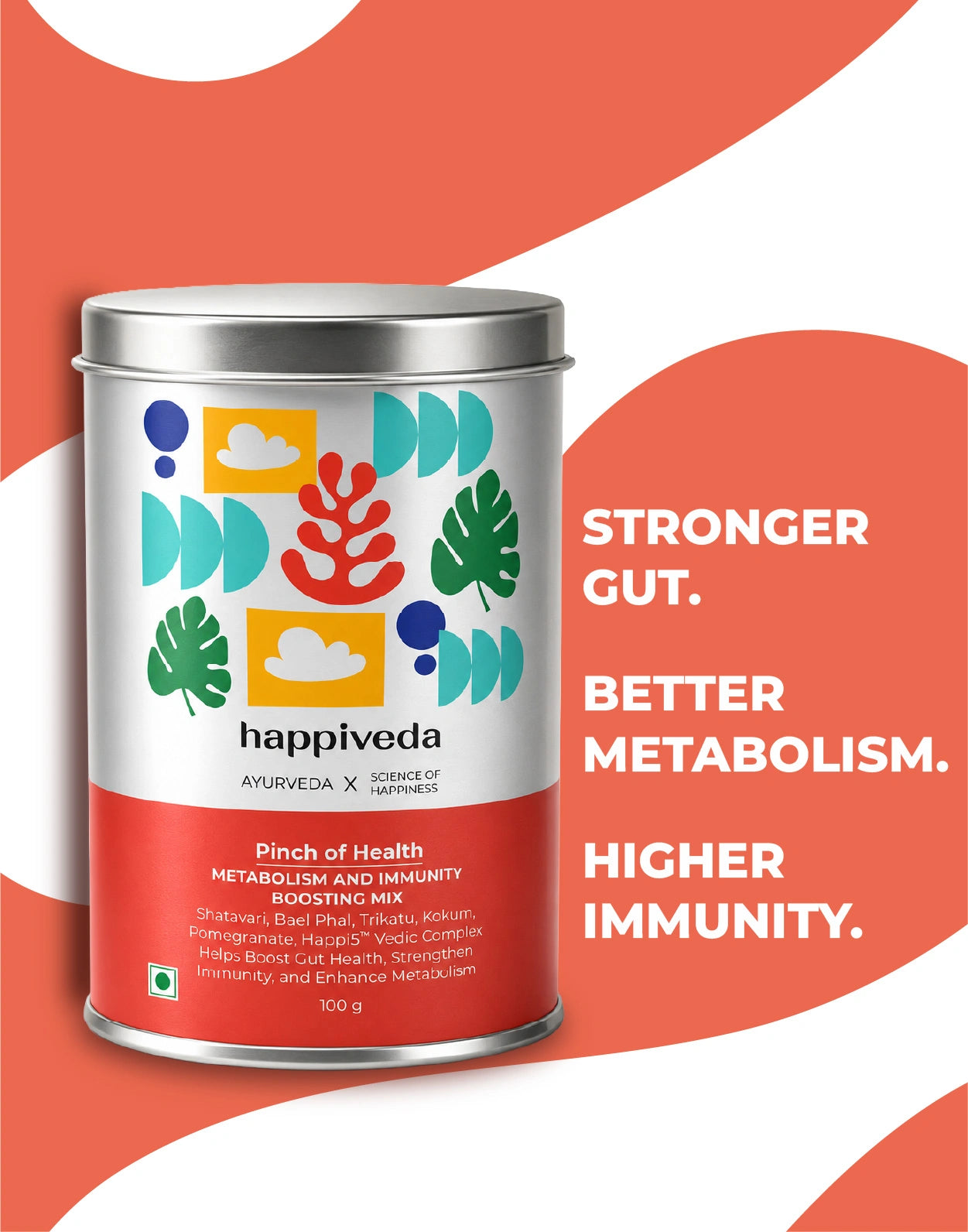
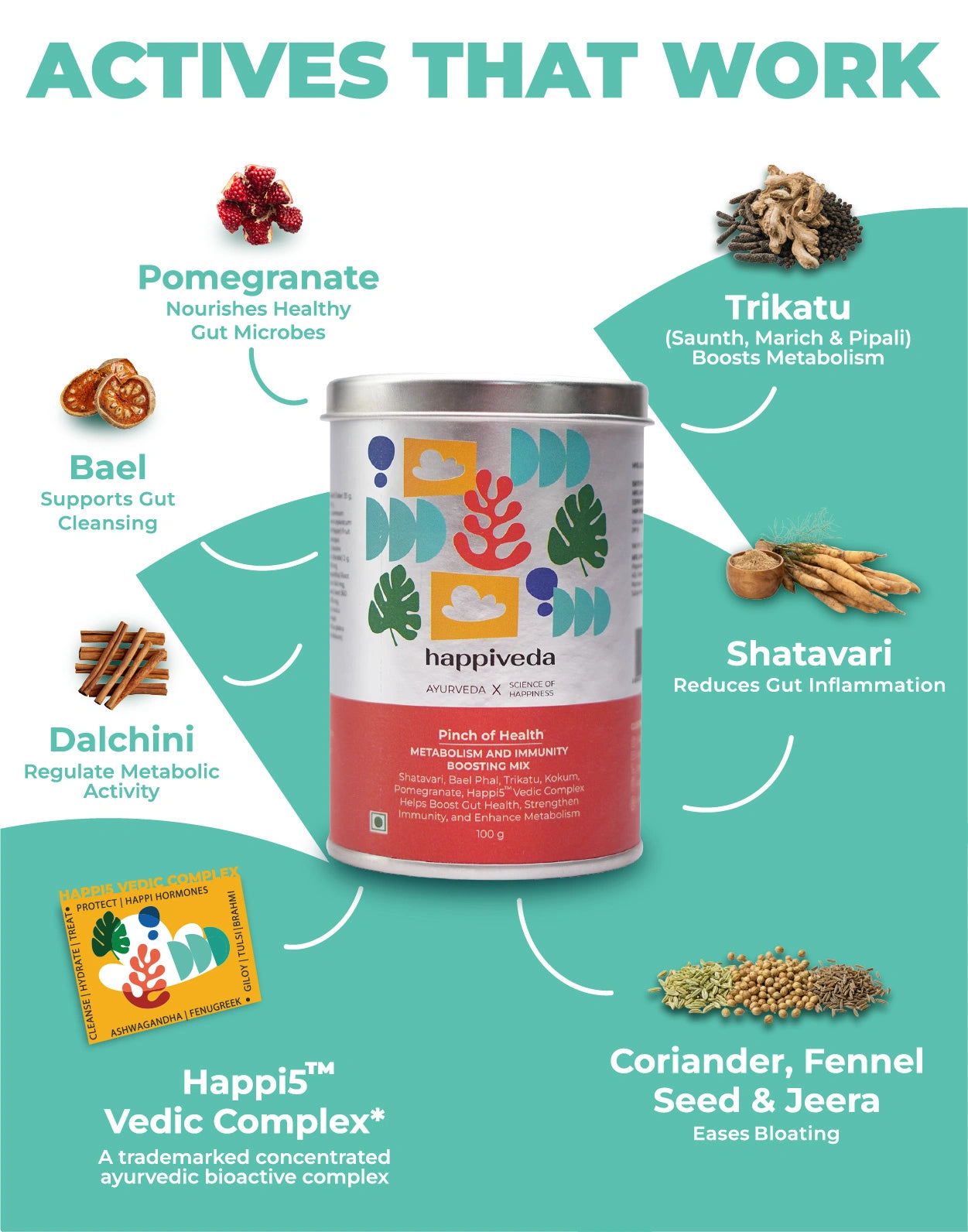
This is where a daily ritual that actually fits your day matters. Happiveda's Pinch of Health --- Metabolism & Immunity Boosting Mix is built on the same ancient wisdom as kanji, but designed for a 9-to-9 day.
It's a blend of 10+ time-tested herbs, spices, and plant-based ingredients:
• Trikatu, Kokum & Dalchini — to wake up a sluggish metabolism and help your body actually process food
• Coriander, Fennel & Jeera — the same trio your dadi reaches for after a heavy meal — to ease bloating and calm gas
• Shatavari & Bael — to soothe an inflamed gut lining and support its repair
• Pomegranate — packed with polyphenols that feed the good bacteria in your gut, doing the same job as a probiotic drink
• The Happi5 Vedic Complex (Ashwagandha, Brahmi, Giloy, Tulsi & Fenugreek) — supporting the gut-stress-immunity loop
The format is genius: it's a sprinkle. Half a teaspoon over your dal, curd, fruit bowl, or smoothie. No pills. No prep. No taste change. 100% vegan, no added sugar, no artificial colours. Think of it as your gut's daily insurance policy — a natural digestion booster in the form you'll actually remember to use.
Building a Gut-Happy Day (No Lifestyle Overhaul Needed)
You don't have to ferment your own kombucha or move to a hill station to fix your gut. A few small things, done daily, do more than any 7-day detox ever will:
• Start with warm water — first thing, before coffee. It wakes digestion up gently.
• Eat sitting down, slowly. Not at your desk. Not while scrolling. Your gut needs to know it's mealtime.
• Add one probiotic-style food a day — dahi, buttermilk, fermented batter, or kanji when it's in season.
• Sprinkle Pinch of Health into one meal a day. Half a teaspoon. Consistency does the work.
• Sleep at the same time every night. Your gut microbes follow your body clock more closely than you'd believe.
• Walk for ten minutes after dinner. Tiny habit. Huge payoff.
Korean beauty made fermentation glamorous. Kombucha made it trendy on Instagram. But the deeper truth — that everything starts in your gut — has been Indian wisdom for 5,000 years. We didn't need to import it. We just needed to remember it.
Start small. Start today. Half a teaspoon of Pinch of Health sprinkled into tonight's dinner — or a fresh glass of kanji this weekend — is a perfectly good place to begin.
Your gut has been waiting.