Puffy under-eyes that no amount of cold spoons can de-puff. A patch of pigmentation looking just a shade darker than last week. That brick-heavy 2pm slump even though you went to bed at eleven and slept all the way through.
If you’ve ever wondered why you’re tired even after 8 hours of sleep, you’re not making it up — and you’re not alone. The CDC reports that more than one in three adults consistently misses out on the restorative sleep their body actually needs. And here’s the part most of us never connect: your skin clocks the deficit long before your energy levels do. Long before you’re yawning at your desk, your face has already filed the report.
Eight hours in bed doesn’t automatically mean eight hours of repair. And the gap between the two is exactly why so many of us wake up looking — and feeling — like we haven’t really slept in weeks.
Sleep Quality vs Quantity: Why 8 Hours Isn’t Enough
Sleep isn’t off time. It’s the body’s busiest shift — a roughly 90-minute cycle that repeats four to six times across the night, and each stage does something completely different.
Stage 1 — Drifting off
Your brain slows, muscles soften, you slip from awake into very light sleep. Easy to wake from. Lasts only a few minutes.
Stage 2 — Light sleep
Heart rate drops, body temperature falls. This stage is the bridge to the real work that follows.
Stage 3 — Deep sleep (the repair shift)
This is the heavy lifting. Your body releases its biggest pulse of growth hormone — the hormone that triggers cell repair, rebuilds collagen, and powers tissue recovery. This is the stage your skin is literally waiting for. Skip it, and your skin doesn’t get its repair shift.
Stage 4 — REM sleep
The dream stage. Cortisol gets flushed out, memories sort themselves into place, and your brain emotionally resets for tomorrow.
A genuinely restorative night looks like four to six full cycles. What most of us actually get is eight hours in bed but maybe two or three clean ones — broken by phones, late dinners, stress, and blue light. You slept. You just didn’t recover.
Ayurveda Said This 5,000 Years Ago — and Called It Dinacharya
The 10pm–2am window today’s chronobiologists call the “repair shift” is the same Pitta window the rishis mapped onto the night sky — the time of deep internal transformation, when ojas (vital essence) is replenished and the body rebuilds itself from the inside out.
Where modern science says “growth hormone peaks during deep sleep,” Ayurveda says rasa dhatu (the nourishing tissue formed from digested food) does its quiet work overnight. Two languages, one truth. Your dadi’s “jaldi so jao, beta” is a peer-reviewed prescription.
Why You’re Tired Even After 8 Hours — The Real Culprits
The honest answer: you might be sleeping, but you’re not recovering. The hours look right on paper, but the sleep architecture underneath has collapsed. The culprits are remarkably ordinary:
• Phone in bed. Blue light suppresses melatonin by up to 50%. The 11:30pm reel is genuinely costing you Stage 3 sleep.
• Chronic low-grade stress. Your body is releasing cortisol when it should be releasing melatonin. You fall asleep — but never drop into deep sleep.
• Eating heavy or late. Your digestive system is running overtime when your repair system is supposed to be in charge.
• Caffeine after 2pm. Caffeine has a half-life of five to six hours. That 4pm chai-coffee is still very much in your system at bedtime.
• Inconsistent sleep timings. Your body clock runs on routine. Sleeping at 11 one night and 1:30 the next is the physiological equivalent of jet-lagging yourself every weekend.
• A stressed gut. Most of your serotonin — the precursor to melatonin — is made in your gut. A bloated, irritated gut is a poor sleep architect.
Sleep isn’t just lying down for eight hours. It’s creating the physiological conditions for deep, restorative sleep to actually happen.
Your Skin Files the Report Before Your Body Does
Long before your body admits it’s tired, your skin has already filed the report. You can run on caffeine, push through the 2pm slump, and convince yourself you’re fine — but your face is rarely as good a liar.
Between roughly 10pm and 2am, your skin shifts into a completely different mode — its peak overnight repair window. Cell turnover accelerates. Collagen production peaks, driven by the growth hormone released during Stage 3 deep sleep. Blood flow to the skin increases, delivering nutrients overnight. The barrier becomes more permeable, absorbing what you give it. Cortisol drops to its lowest point — meaning less inflammation, less excess oil, less pigmentation going off-script.
A 2015 study by Oyetakin-White et al. in Clinical and Experimental Dermatology found that poor sleepers showed significantly higher signs of intrinsic skin ageing, slower barrier recovery, and lower satisfaction with their appearance. A separate 2010 study by Axelsson et al. in the BMJ found that strangers could identify sleep-deprived faces as “less healthy” within seconds. Your skin is the most honest organ you have. It cannot fake rest.
What bad sleep quietly writes on your face
• Dullness that no highlighter fixes — skin cells didn’t turn over properly overnight.
• Pigmentation deepening, or fresh patches appearing — elevated cortisol directly stimulates melanin.
• Stubborn dark circles — sleep-deprived blood vessels under the thinnest skin on your face dilate and pool.
• Random breakouts on a “non-stress” week — higher cortisol drives more sebum, which clogs pores.
• Skin that feels drier, tighter, or more sensitive — overnight barrier repair didn’t finish the job.
• Fine lines looking deeper than they did a month ago — less collagen got made.
The Modern, Effortless Way to Support Your Sleep & Skin Together
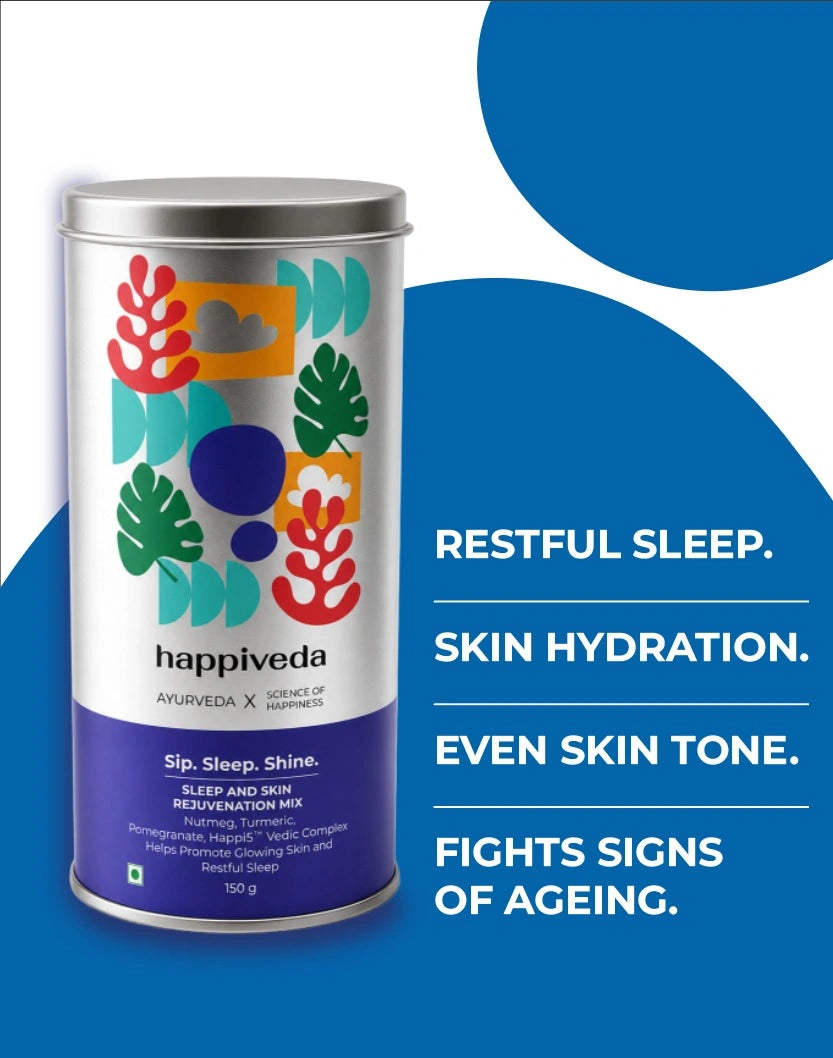
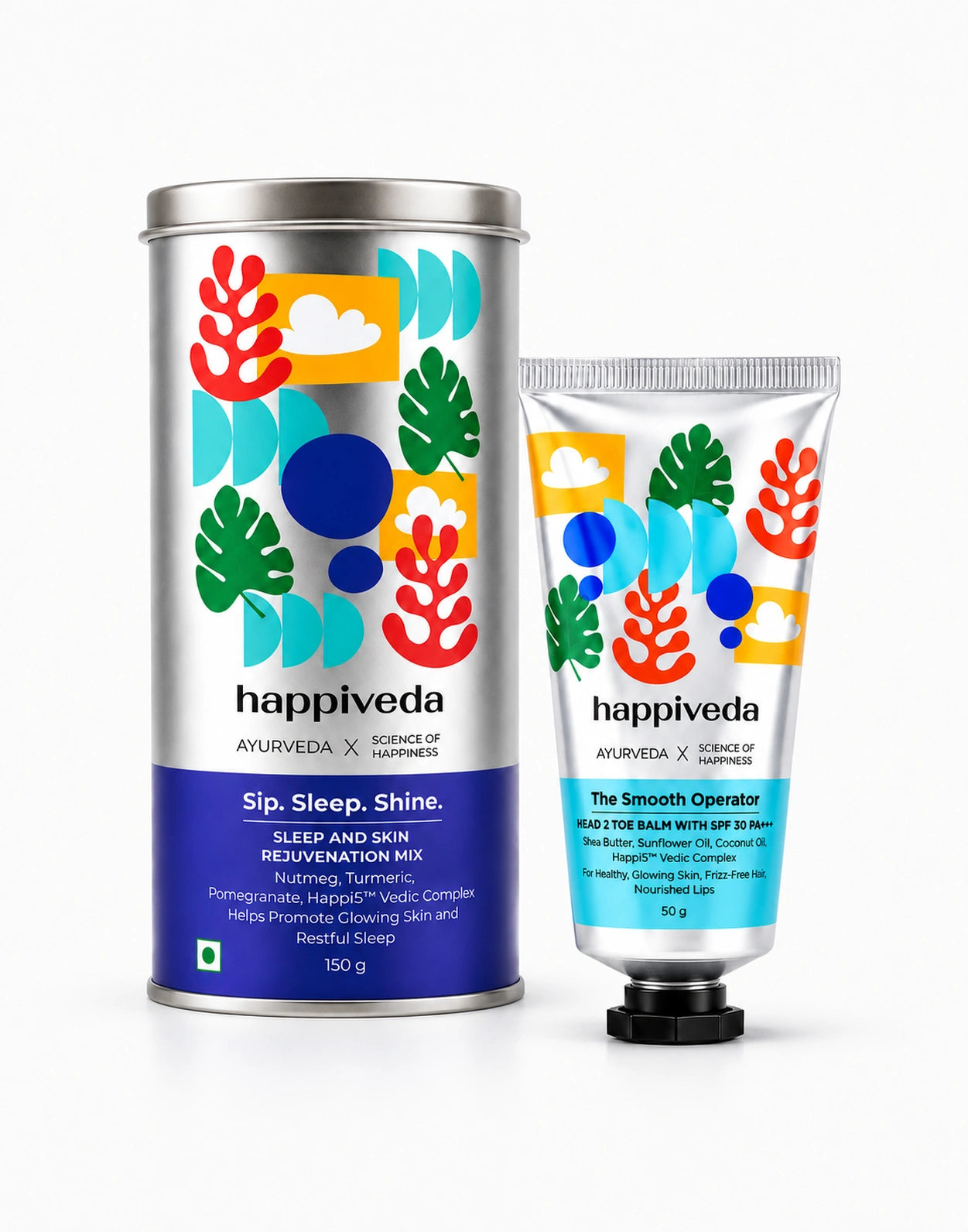
The trouble with most sleep advice is consistency. Real life doesn’t always cooperate with a perfect 10pm wind-down. This is where a daily ritual that actually fits your day matters — and it’s the thinking behind Happiveda’s Sip. Sleep. Shine. — Sleep & Skin Rejuvenation Mix.
It’s not a sleeping pill. It’s a dual-action nightly ritual built around exactly the two processes you’ve just read about: easing the stress that disrupts restorative sleep, and supporting the overnight skin renewal that depends on it.
The sleep-support side — Ayurvedic adaptogens
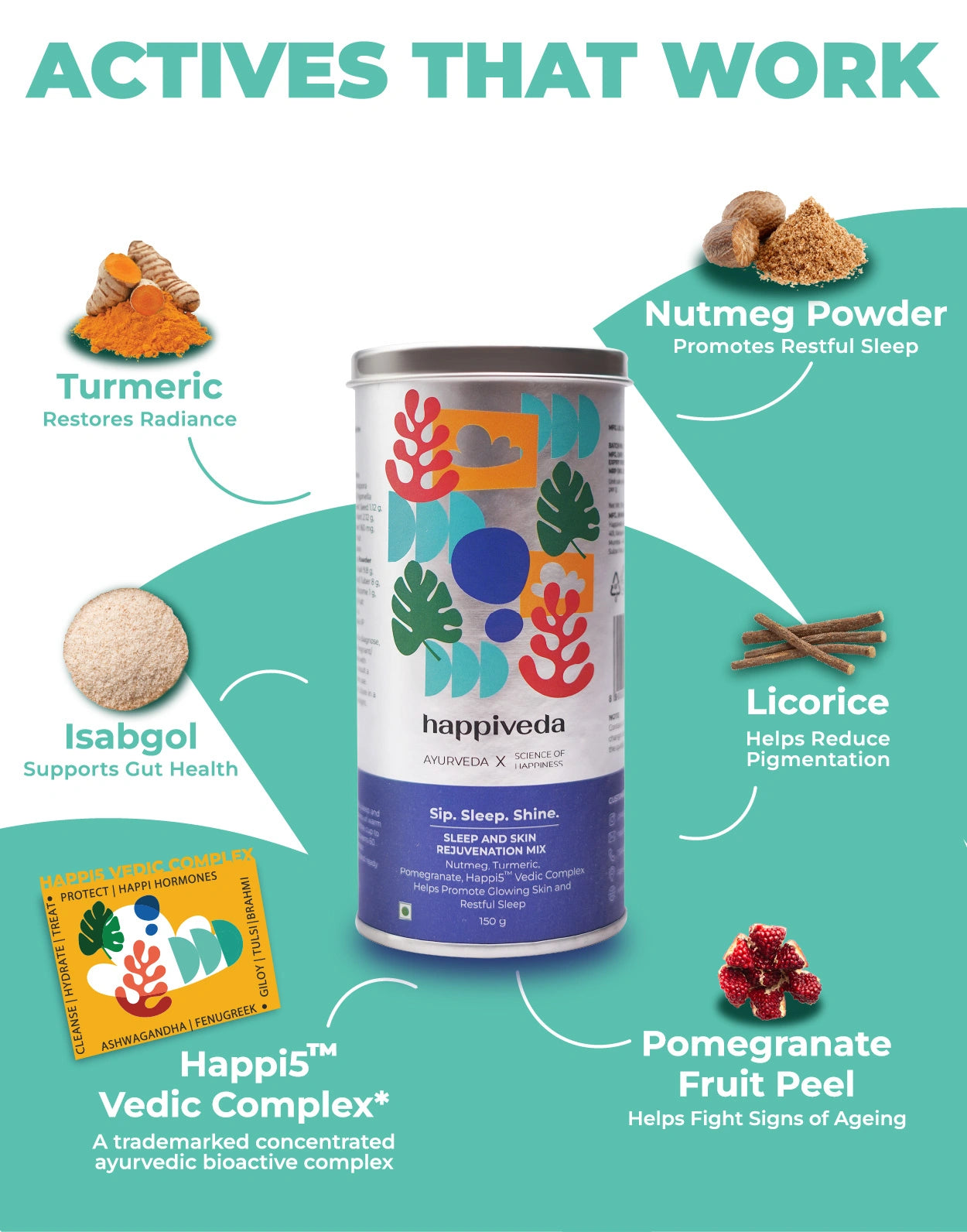
• Ashwagandha — one of the most clinically studied adaptogens, with withanolides researched for healthy cortisol balance during stress.
• Brahmi — traditionally used for calm and clarity, with bacosides studied for their interaction with the nervous system’s GABAergic relaxation pathways.
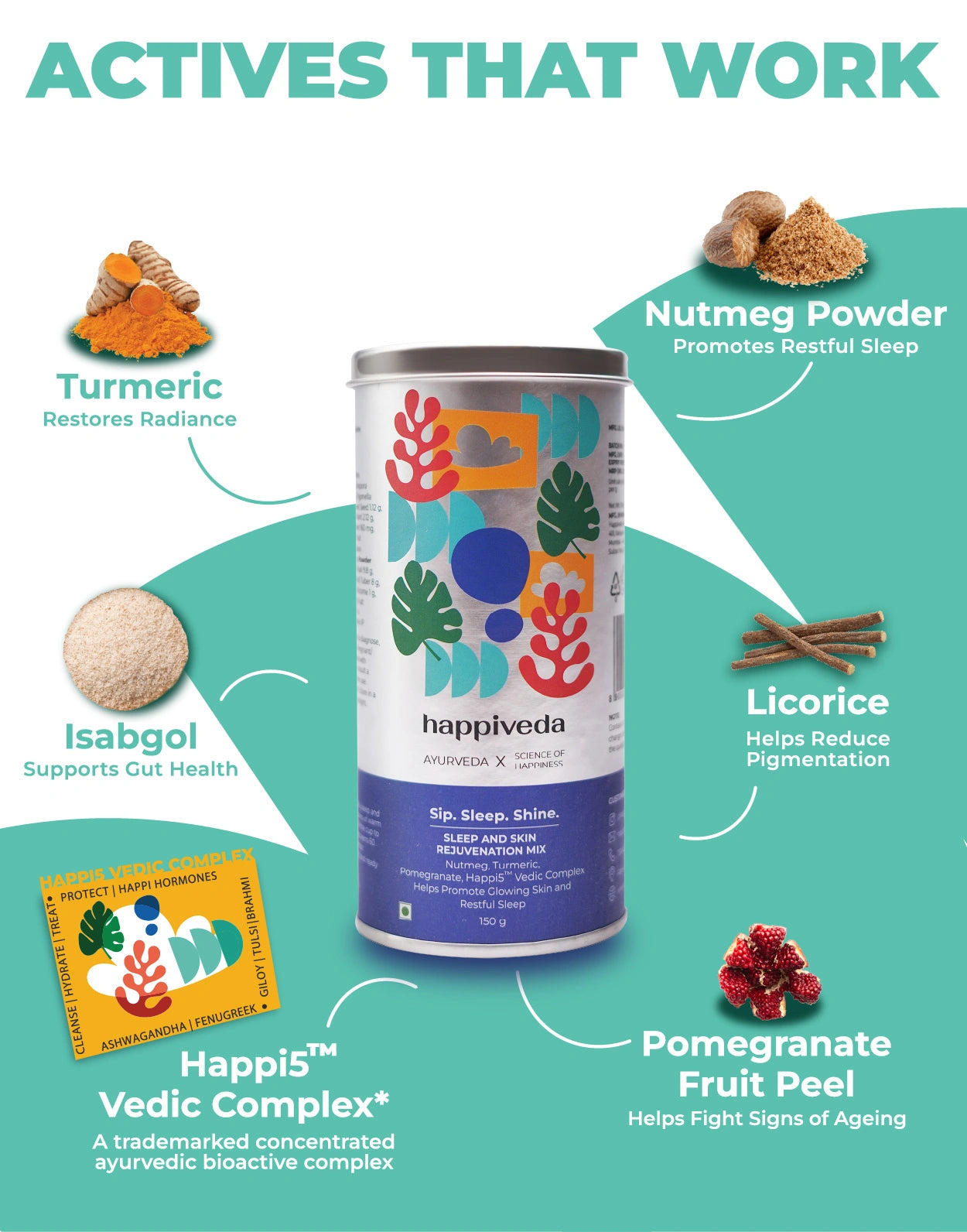
• Nutmeg — gently grounding, traditionally used to ease the body into rest, with compounds explored in early research for their role in serotonin-related pathways.
The skin-support side — plant bio-actives that work while you sleep
• Licorice — glabridin, studied for brighter, more even-looking skin via tyrosinase activity.
• Pomegranate peel — ellagitannins and polyphenols, studied for collagen integrity against oxidative stress.
• Turmeric — curcumin, studied for supporting the body’s inflammatory balance and skin wellness.
• Fenugreek — galactomannan mucilage, explored for moisture-supportive and skin barrier properties.
The format is genius: a warm, sip-worthy bedtime drink. No pills. No prep beyond a kettle. 100% vegan, no added sugar, no artificial colours. One ritual. Two cycles supported. The way Ayurveda intended.
Building a Sleep-Smart Night (No Lifestyle Overhaul Needed)
A few small things, done daily, do more than any sleep gadget ever will:
• Phone curfew at 10pm. Even one hour of blue-light-free wind-down measurably lifts melatonin and shortens the time to Stage 3 sleep.
• Finish dinner by 8pm. Give your digestive system a clean handover to your repair system. Late, heavy meals delay the cortisol drop your skin is waiting for.
• Move your last coffee earlier. A 2pm caffeine cutoff is non-negotiable for clean deep sleep. Switch the 4pm cup to a herbal alternative.
• Anchor your sleep timing. Same bedtime, same wake time — even on weekends. Your circadian rhythm rewards consistency more than total duration.
• 10 minutes of morning sun. Within an hour of waking. It sets your melatonin clock for the night ahead.
• Sip Happiveda's Sip. Sleep. Shine. about an hour before bed. Let the ritual do its work while you wind down.
Start tonight. Even one small shift. Your skin has been waiting.