What Is Waterless Skincare? Why Concentrated Skincare Could Be the Future of Face Wash
Turn over almost any bottle of face wash in your bathroom right now and read the first word on the ingredient list. Nine times out of ten, it says Aqua. Water. Not the turmeric, not the aloe vera, not whatever active ingredient actually sold you on the bottle — water, quietly doing the job of filling up the other 70 to 80 percent of it.
I spent the better part of two decades in India's beauty industry, including running Lakmé Lever, and if there's one thing that never stopped nagging at me, it's how much of what we sell people in this country is water wearing very good packaging. So when "waterless skincare" started showing up everywhere — Seoul, Santa Monica, and now Happiveda's own labels — I wanted to actually explain what it means, instead of letting it become one more shelf buzzword nobody can define on the spot.
What does "waterless" skincare actually mean?
Waterless skincare (the technical word is anhydrous) simply means a product formulated without water as its base. Most face washes, lotions and creams use water as filler — cheap, easy to preserve, and the reason a 100ml bottle mostly contains 100ml of very little. A waterless or concentrate product replaces that water with the actives themselves: plant extracts, oils, herbal complexes, humectants — the ingredients actually doing something for your skin, undiluted.
It's not a new idea. Balms, oils and solid cleansing bars have been waterless forever. What's new is the industry finally admitting, out loud, that "concentrated" and "effective" tend to go together — and building entire product lines around that instead of hiding it in the small print.
So what exactly is a "concentrate" cleanser?
A concentrate cleanser is the liquid-adjacent cousin of a waterless product: it looks and feels like a gel or cream, but it's built with zero added water, so every gram is active ingredient rather than filler. You add the water yourself, at your own sink, at the exact moment you need it — instead of paying to ship, store and preserve water that was added at a factory months earlier.
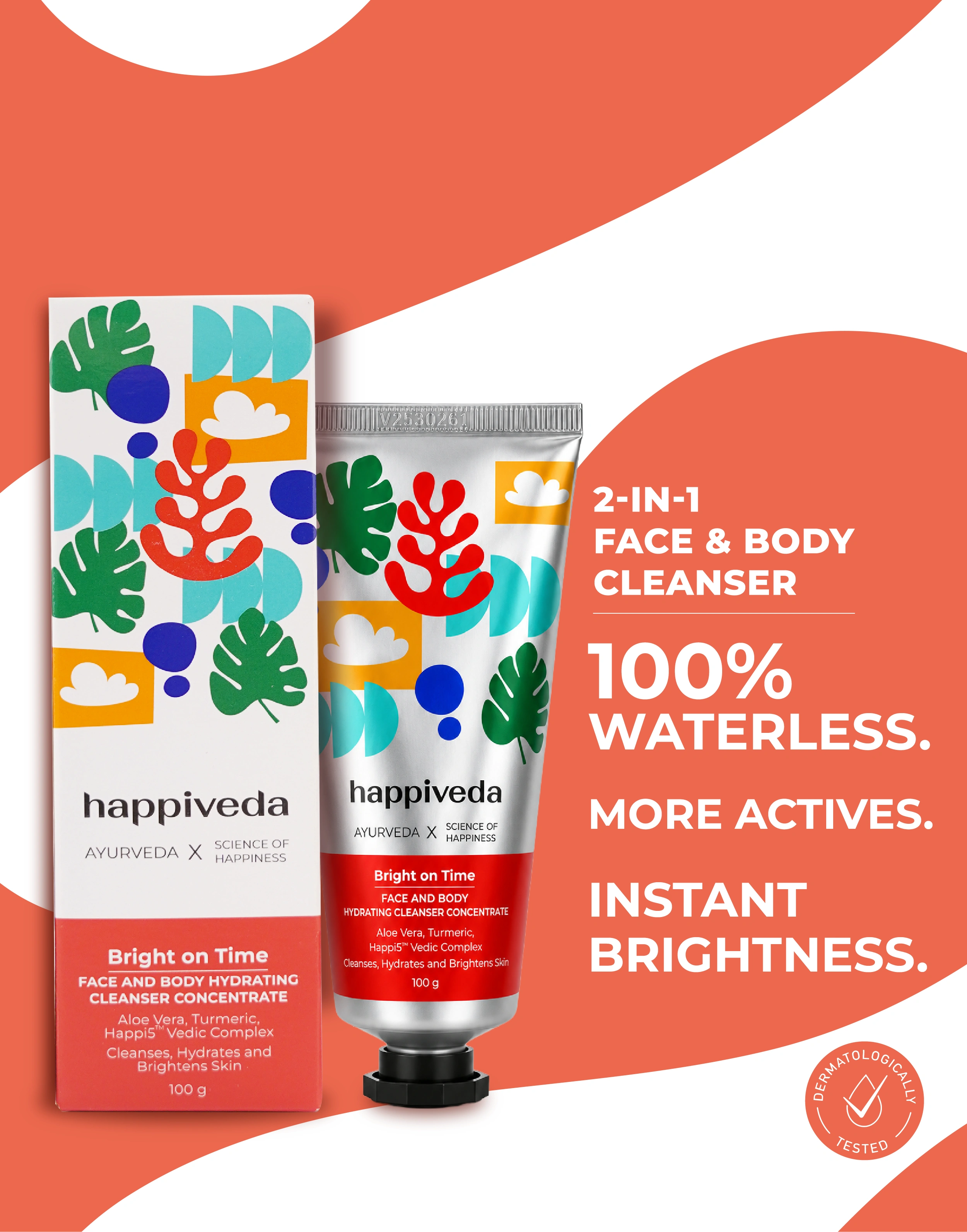
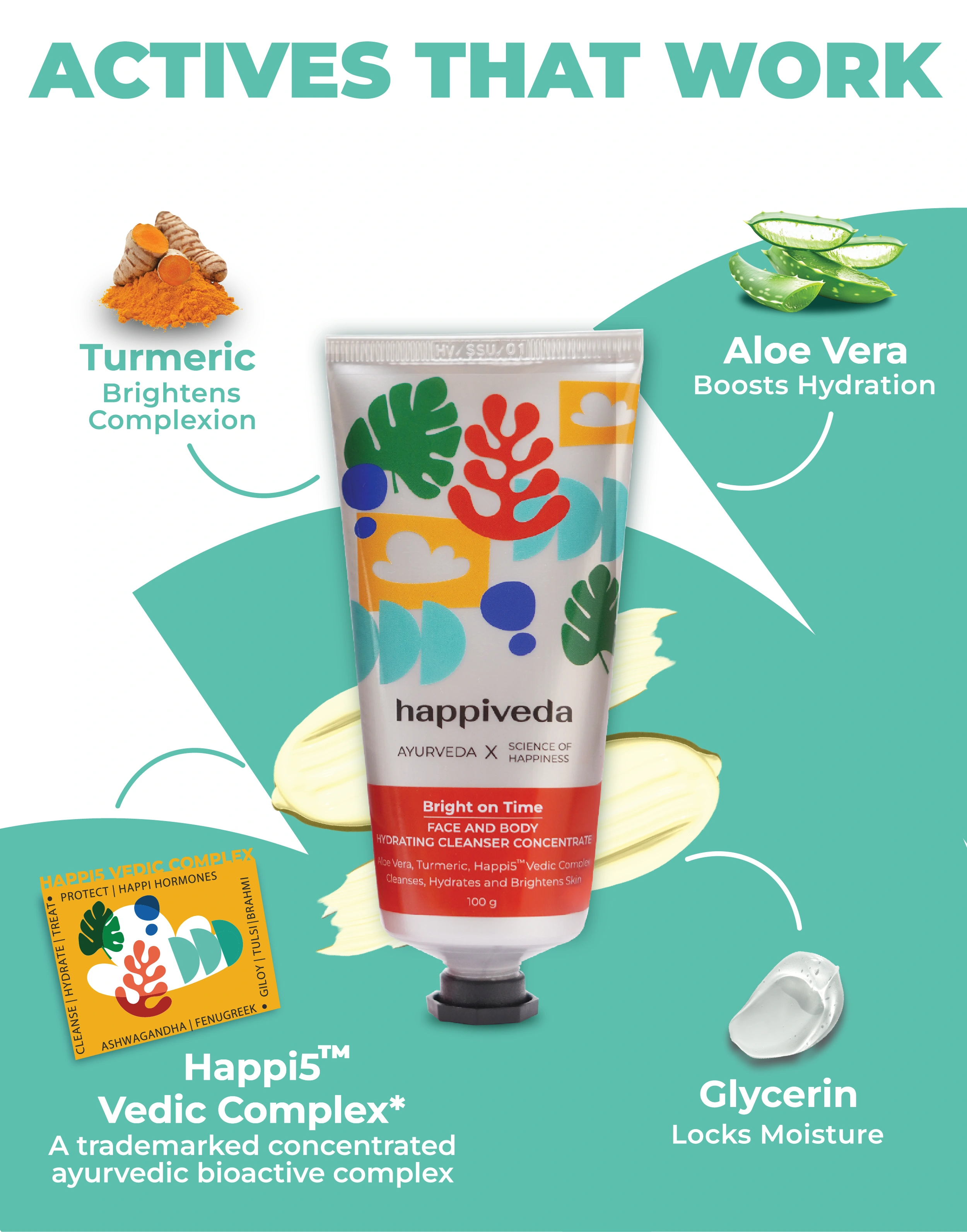
Bright on Time, our own face and body cleanser, is built exactly this way — a 100% waterless concentrate blending aloe vera, turmeric and our Happi5™ Vedic Complex (ashwagandha, brahmi, giloy, tulsi and fenugreek). You take roughly a one-centimetre drop, add water in your palm, and the formula activates on contact — rather than arriving pre-diluted and already doing half the job before it's even touched your face.
Does more concentrated actually mean more effective?
Mostly, yes — and the logic is refreshingly simple. If a regular face wash is 75% water, you need a much bigger dollop to get the same dose of actual active ingredient onto your skin. A waterless concentrate needs a fraction of that per use, because there's no water there to dilute it in the first place.
That's also why a well-made concentrate tends to outlast a regular bottle of the same size — you're using less product per wash to get the same (often stronger) result. It's the reason we can make a genuine "2× more uses" claim on Bright on Time: you're not getting a smaller bottle for the same price, you're getting a bottle that was never carrying dead weight to begin with.
There's a knock-on benefit too. Water-based formulas need preservatives to stop that water from growing something you don't want on your face. Waterless formulas need far less of that — which is a quieter, less-hyped reason clean-beauty labels keep circling back to concentrates.
Regular face wash vs. a waterless concentrate
|
Regular face wash |
Waterless concentrate |
|
|
Typical water content |
60–80% |
0% |
|
Product used per wash |
More (diluted formula) |
Less (undiluted formula) |
|
Preservative load |
Higher, to protect the water |
Lower |
|
Bottle life at same size |
Shorter |
Typically longer |
|
What you're paying for |
Formula + water + shipping water |
Mostly formula |
Why this matters more in India than almost anywhere else
Here's the part that goes beyond skincare marketing. India isn't short on reasons to think harder about water. NITI Aayog's Composite Water Management Index has flagged that roughly 600 million Indians face high to extreme water stress, with demand projected to outstrip supply within the next few years. That's not a talking point we borrowed from a global sustainability trend — it's a genuinely Indian problem, and formulating without water, at scale, is one small but real way a beauty brand can decide not to add to it.
There's a skin-specific reason too. Indian humidity and hard water vary wildly by city and season — Mumbai in July is not Delhi in December — and a water-based formula behaves differently depending on the water it's mixed with at the factory. A concentrate sidesteps that variability altogether, because the water you add is the water in your own home, in the moment you're using it.
Is waterless skincare right for you?
Broadly, yes, for most skin types — a well-formulated concentrate is gentle enough for daily use on all skin types, which is why Bright on Time is built to work as both a face and body wash. A few things worth knowing before you switch:
-
Oily and combination skin tend to like concentrates a lot, since you control exactly how much product (and how much water) touches your skin — less risk of over-washing or stripping.
-
Dry or sensitive skin should look for a concentrate built around aloe vera, glycerine or similar humectants rather than one leaning on strong actives alone, so hydration isn't sacrificed for concentration.
-
Combination face-and-body use is where waterless concentrates genuinely earn their keep — one bottle doing a job that used to take two or three.
As always: patch test before daily use, and if you're pregnant, breastfeeding, or managing a diagnosed skin condition, check with a doctor before switching your routine, waterless or otherwise.
How to actually use a concentrate cleanser
Because you're adding the water yourself, technique matters more than it does with a regular face wash:
-
Activate it — take about a one-centimetre drop (five centimetres if you're using it on the body), add a little water, and rub palms together to warm the formula before it touches skin.
-
Massage, don't just rinse — work it in upward, circular motions for 20–30 seconds. This is where a concentrate actually outperforms a diluted formula, since you're giving the actives real contact time.
-
Rinse and pat, don't rub dry — pat skin dry to lock in whatever the formula just deposited, rather than wiping it straight back off with a towel.